Productivity · project documentation
Documentation templates for reusable web project decisions
A lightweight decision record that keeps context, constraints and the next handoff in the same place.

The useful version of a web practice is the one that can be repeated by someone else. This note keeps the scope tight, names the trade-offs and ends with a way to check the result. Continue with the project documentation index or meet the Sites To Use editorial desk behind the notes.
Write the decision before the explanation
A reusable note starts with the choice in one sentence. Then capture the context that made it reasonable, the constraints that shaped it and the alternatives that were considered. This order makes a document useful to someone who was not in the meeting.
Avoid turning the record into a transcript. The purpose is not to preserve every thought; it is to preserve the reasoning needed to revisit the work.
Name the edges
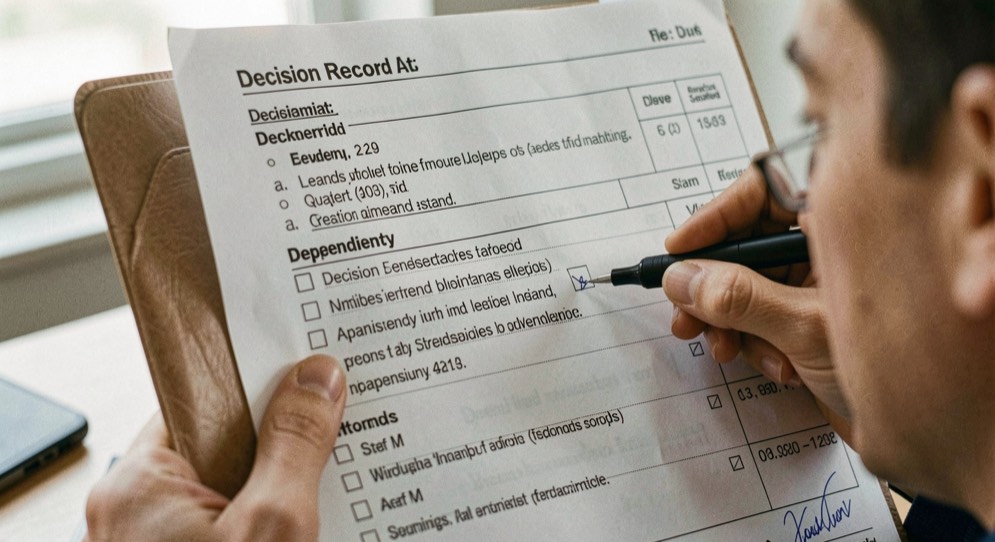
A decision becomes easier to maintain when its edges are visible. Note which pages, components or dependencies it affects, and which questions are explicitly deferred. A short list of non-goals protects the project from quietly expanding while nobody is looking.
Use links to the relevant source files and checks. A handoff is stronger when it can move from explanation to evidence in one step.
Let the template stay small
If a template takes longer to complete than the decision deserves, people will route around it. Keep required fields few, use prompts for nuance and review the format after a real handoff. The best template is the one that leaves a clearer trail without becoming a second project.
Use a record when the choice has consequences
Reserve a decision record for a choice that changes architecture, publishing, cost, risk or future work. Start with a title that states the decision, then add status, context, options considered, outcome and consequences. Name who owns the decision and the date it becomes effective. A future reader should be able to understand why the choice was reasonable without reconstructing a meeting or searching several chat threads.
Link the record to the affected repository, component, contract or measurement. Include the assumptions that would justify revisiting it and mark superseded records rather than rewriting history. The GDS guidance treats the record as a concise account of title, status, context, decision and consequences. MADR adds structured comparison when the options and trade-offs need more detail. Choose the smallest form that preserves the reasoning.
Choose documentation tooling by retrieval cost
Plain Markdown beside the code offers version history, review and portability with little infrastructure. A hosted knowledge base can provide stronger search, permissions and non-technical editing. Compare tools using a real handoff: ask a new collaborator to locate the current decision, identify what it affects and follow its evidence. Measure the time and note where permissions, stale links or duplicate pages interrupt the route.
For a paid platform, examine export formats, API access, revision history, backups, guest roles, full-text search, link checking, templates and renewal pricing. Confirm what remains accessible after cancellation. Define one canonical home for accepted decisions and use other systems only to discuss drafts or point back to it. A polished template cannot compensate for records scattered across systems that no one knows how to search.
A decision record should also note the jobs a machine runs without a person present. On a web project, that means backups, log rotation, cache clearing and report generation, each with its schedule, its owner and the command it executes. Documenting them turns an invisible habit into something a new maintainer can audit. The same principle applies to the desktop tools behind the work, as in this note on scheduling tasks on a Mac, which covers database clients and recurring jobs. Write the schedule down before it becomes folklore.
Sources and further checks
These primary and official references define the standards or product behaviour used in this field note. Accessed August 25, 2026.